Category: Analysis

  • Three Rail fires in three months: some facts and thoughts

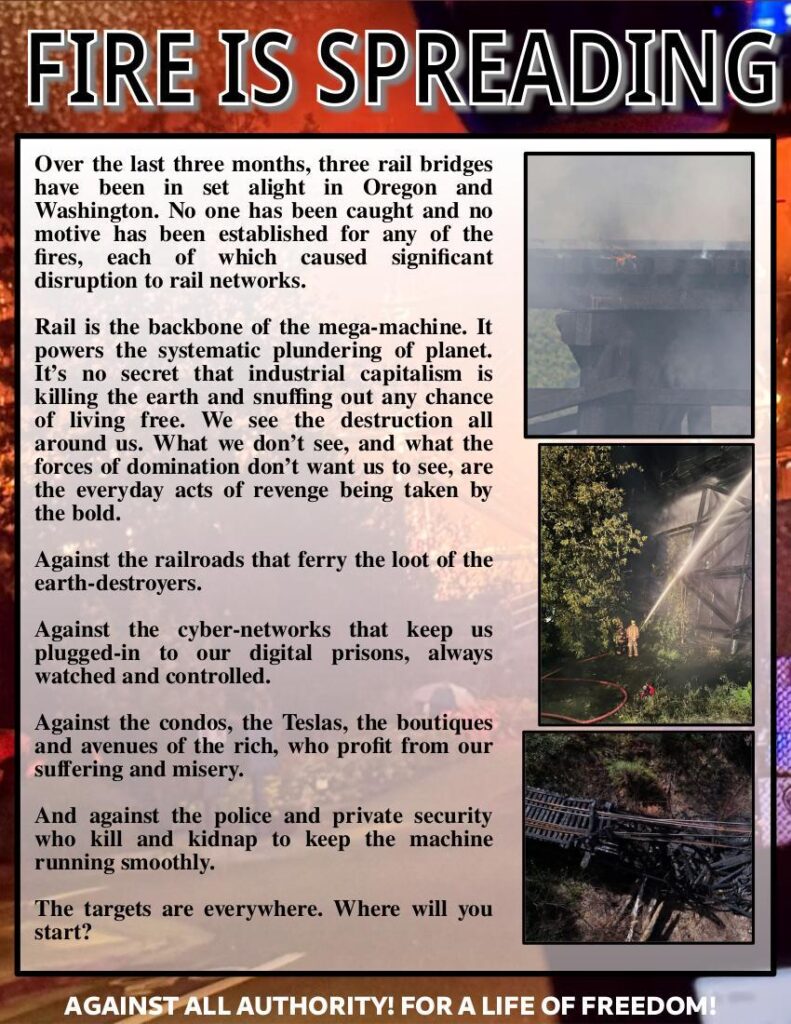
    Over the last three months, three rail bridges have been damaged or destroyed by fires in the Oregon and Washington area. Each of these fires was set intentionally. No arrests have been made, and to our knowledge, none of these actions have been accompanied by any claim or explanation.

    But the world around us is the only explanation we need.

    As we barrel forward towards a future of untold climate disasters and total ecological mutilation, the processes of extraction show no sign of stopping… They have only accelerated, with companies racing to exploit new corners of the earth for rare-earth minerals, essential components in chips and semi-conductors, the building blocks of our new digital prisons. Power has proposed false “green solutions” that only serve to further our dependence on technology and extraction and polish the face of industrial capitalism.

    (more…)
  • Suggested tactical improvements – a response to Some Anarchists letter

    Hey there,
    I’m Rebel Rabbit and I reviewed the Rose city counter info blog post from Some Anarchist. I’d like to offer a Clearer Argument (based on Some Anarchists piece).

    Some points out that protests at the ICE office have become stuck in a loop: people show up, clash with feds, leave, and repeat. This has not shut ICE down or shifted power. To move forward, she argues, we need to change tactics.

    (more…)
  • A Public Letter Regarding Some Impasses in Portland

    My dearest brambles,
    Regarding the ICE ERO Field Office: we know the air there, thick with rot.
    Each night, a handful wait until the kitted-out feds kick their asses,
    then limp away, to try again,
    as if only repetition is the ritual needed to conjure change.
    A valiant rite,
    yet the building still hums with its cruel machinery.

    (more…)
  • All Cameras are Cops

    On July 25th, the FBI conducted an early morning raid on a home in Portland and kidnapped a 24 year-old on federal charges related to a protest at the ICE building. They are facing up to 20 years in prison for allegedly “assaulting an officer” and damaging the facade of the ICE facility in SW Portland in early June. The FBI identified them by running a photo (in which their face was visible) through facial recognition search software. The photo was taken by Mark Graves, a photographer from the Oregonian.

    (more…)
  • Some Initial Thoughts On Unity Of Fields

    [I am writing as an insurrectionary anarchist in the u$a and speaking to that context]

    Unity Of Fields is a counter-info project that emerged in August of 2024. They describe their project as “a militant propaganda front against the US-NATO-zionist axis of imperialism.” It used to be Palestine Action US and has since changed its orientation. It has a website and some social media accounts, some of which have are banned at the time of this writing, they seem to be most popular on Telegram. Although it links to mostly anarchist sources for technical knowledge, Unity Of Fields does not seem to be an anarchist project and their political reading and media suggestions are all over the map. They suggest classic decolonial texts by Fanon and Cesaire, Black liberation writings from the BLA and BPP, texts from various Palestinian resistance factions, as well as authoritarian communists like Lenin and Mao among others.

    Mostly their website is a clearing house for news, action analysis, and communiques. Many of the communiques posted are original submissions though they also repost from other counter-info projects and from social media. They also post some of their own original writings to their website. The fact that they post sketchy criminal stuff and link to technical advice on how to better carry out insurrectionary forms of struggle is probably a large part of why they are discussed in anarchist circles at all.

    What does the emergence of a project like Unity Of Fields mean for us as anarchists? For one thing Unity Of Fields expands some spaces we occupy as anarchists — the combative struggle space and the digital counter-info space. We are clearly not the only ones re-coloring walls, opening windows, and carrying out our little sabotages and then writing about it, though at least for now others seem to look to our collective knowledge and experience for technical guidance. We are sharing a struggle space, one which is not limited to riotous moments and combative demonstrations, with other rebels who have made themselves visible to us. We are being included (at least some of the time) in a dialogue with other rebels through the sharing of our words and news of our actions, and anarchists have shared writings from Unity Of Fields on our own websites.

    Local struggles against zionism, imperialism, and colonialism are visibly taking on more destructive, decentralized, anonymous, and autonomous approaches, a long-term dream of insurrectionary anarchists, yet new questions arise for us. How do we want to contend with other rebels with whom we have ideological differences and tactical similarities? How do we avoid getting lost in the vanguardist, unifying, nationalist tendencies that often accompany revolutionary leftist approaches to combative struggle? Are we interested in conspiring with these others outside the spontaneity of spiky demonstrations, occupations (and potentially riots), and if so how? (more…)

  • To the International Anarchist Movement: Three Security Proposals

    This text is addressed to the international anarchist movement, which we’ll define as the sum of individuals fighting for anarchist ideas around the world. This movement is in conflict with its natural enemies — the State, fascist groups, and so on — and must protect itself if it is to survive in this conflict. In this text, we make three proposals for the international anarchist movement to consider in the coming years in order to allow anarchists to continue attacking while limiting their chances of getting caught.

    1. Share knowledge internationally

    Our enemies organize internationally through cooperation between police and intelligence agencies and new developments in science and technology — the increasing precision of DNA forensics and the proliferation of drones being just two examples. This means that a repressive technique used in one country may soon appear in another where it is not yet being used. It also means that an effective countermeasure used by anarchists in one country may be effective in another. We should therefore share knowledge of repressive techniques and countermeasures on an international level.

    Ideally, any experience of repression or experimentation with countermeasures that might be of interest to other anarchists should be written up, translated into several languages, and made public. When anarchists are arrested and brought to trial, we can often obtain court documents that reveal how they were caught: we should exploit this and publish analyses of such documents, bearing in mind that information obtained in this way may be partial or distorted. We should experiment with new countermeasures and write and publish reports on these experiments (except in cases where the State might adapt and weaken the countermeasure by reading the report). We should try to collect information at the source: read police training manuals, steal police files, analyze data leaks from police servers.

    A specific feature of the international anarchist movement is its decentralization. We see this not as a weakness but as a strength: in addition to preventing the hierarchies inherent in centralized organizations, it makes it harder for our enemies to target us because they cannot topple the whole movement by disrupting one part of it. However, this decentralization also makes it harder for us to share knowledge across borders. To overcome this, we see two options: developing informal bonds with other anarchists by meeting at international book fairs and other events, and using the Internet. We propose using the No Trace Project as an international platform to share the knowledge that is suited for sharing on the Internet, not as a replacement for informal bonds but as a useful supplement to spread information beyond existing informal networks.

    2. Establish a security baseline

    Anarchists who carry out direct actions should analyze the risks associated with their actions and take appropriate precautions: dress anonymously, be mindful of video surveillance and DNA traces, and so on. However, this is not enough. If only those who carry out actions take precautions, it is easier for our enemies to target these individuals. This is, firstly, because they stand out: if only a handful of comrades always leave their phones at home, for example, this could be an obvious starting point for an investigation with no other specific leads. And secondly, because our enemies can get information about them through their friends who do not carry out actions: if someone doesn’t use social media but is mentioned on their friends’ social media, for example, an investigation could query their friends’ social media to get information about them. We should therefore establish a security baseline that everyone in anarchist networks agrees to follow, including those who have never carried out direct actions and have no intention of doing so.

    We can’t say what this baseline should be, as it will depend on each local context, but we can give some ideas. As a bare minimum, everyone should help hide information from our enemies by not speculating about who is involved in an action, not bragging about one’s own participation in an action, not talking to the police, and encrypting any computer or phone used for conversations with other anarchists using a strong password. Discuss sensitive matters exclusively outdoors and without electronic devices, and don’t make it obvious to your social environment who you are having sensitive conversations with (e.g. don’t ask someone to “go for a walk” in front of people who aren’t involved in the project being discussed). In addition, we think everyone should stop using social media (and definitely stop posting photos of other anarchists, even with their consent, because this helps the State map anarchist networks) and leave their phones at home at all times (not just during actions). Carrying your phone with you has security implications for everyone you interact with.

    It can be difficult to convince people to follow such a security baseline, especially if they think they have no personal interest in following it. If someone is reluctant, we should remind them that it’s not just their security that’s at stake, but also the security of other anarchists around them who may be carrying out or planning to carry out direct actions. Everyone who wants actions to happen has an interest in making anarchist networks as difficult as possible for the authorities to repress.

    3. Explore new horizons

    Our enemies evolve over time as they refine their strategies and techniques. We should prepare not for the battles that already took place, but for those yet to come. We should therefore go beyond our current security practices, anticipate the evolution of our enemies, and develop new countermeasures.

    Here are three issues we think the international anarchist movement should explore in the coming years.

    Drones

    Aerial surveillance is rapidly becoming cheaper and more efficient. How should we react to the presence of police drones at riots, anarchist events, and so on? How can we detect or take down drones? Should we prepare for the risk of drones being used for routine aerial patrols, and if so, how?

    Facial recognition technologies

    In 2023, a journalist tracked down German left-wing militant Daniela Klette, who had been in clandestinity for decades, by using facial recognition technology to match a decades-old photo of her with a recent photo from Facebook taken during a dance class. What can we do against this threat? How can we prepare for the increasing integration of facial recognition technology into public video surveillance systems?

    Lack of insight into police activity

    Until a few years ago, radio scanners were used by anarchists to monitor police frequencies, for example to learn about nearby police activity while carrying out a direct action. In most contexts, this is now impossible because police communications are encrypted. Can we develop new techniques to functionally replace radio scanners or, more generally, to gain insight into police activity in a given area?

    About the authors

    We’re the No Trace Project. For the past three years, we’ve been building tools to help anarchists understand the capabilities of their enemies, undermine surveillance efforts, and ultimately act without getting caught. We plan to continue in the years to come. We welcome feedback. You can visit our website at notrace.how, and contact us at notrace@autistici.org.

    This text is available as a zine (in Letter and A4 dimensions).

    Let’s prepare ourselves, and may luck be on our side.

    from No Trace Project
  • Additional Thoughts on May Day and the PSU Occupation

    This piece is a little bit late to the party, but after reading the other reportbacks published locally and participating in discussions with dear friends and close strangers, we still felt that some ideas were in need of sharing. We don’t wish to recap the events of May Day but hope to contribute some thoughts and expansions on other takeaways of the occupation and the march. As Palestine solidarity actions continue to grow, we feel that these points are still important. Additionally, much of what we have to say applies far beyond this struggle. What follows is a compilation of thoughts from a few different voices, which we hope can add to the conversation. (more…)

  • Quick thoughts on Refaat Alareer Memorial Library

    In a beautiful occupation, self appointed leaders definitely took a toll. There were a lot of people starting convos about who to let in. Mostly informal, but some attempts at solidifying it in weird meetings. Some people decided to work the door. Instead of focusing on welcoming people, giving them encouragement to act autonomously, and making sure they have skills to stay safe from repression, many decided to try to sus out who’s a cop or not with it and turn people away. (more…)

  • On Delusion

    On May 2, 2024, in a joint press conference with the Portland Police Bureau and PSU President Ann Cudd, Mayor Ted Wheeler denounced the militant solidarity actions of the Student Intifada, claiming: “If you believe that damaging these businesses or trashing a library on a university campus will impact events in the Middle East, you are delusional.” (more…)

  • April 29th: Reflections on the beginning of the Portland State University library occupation

    The spirit of the Intifada swarmed through the Portland State University (PSU) library as a whirlwind. Computers, printers, and televisions made with Coltan, a mineral extracted via slave labor in the Congo, had been smashed throughout the first floor. Commodified food and drinks were transformed into becoming free stuff that anyone can take to consume without paying any money. Cameras got smashed and the first floor changed from a surveilled stuffy work site into being a community social center decorated with beautiful political art on the walls. The gusts of this Intifada disrupted space and time totally, as anarchy revealed itself for the liberating force it is against oppression by attacking the present state of things.

    (more…)